
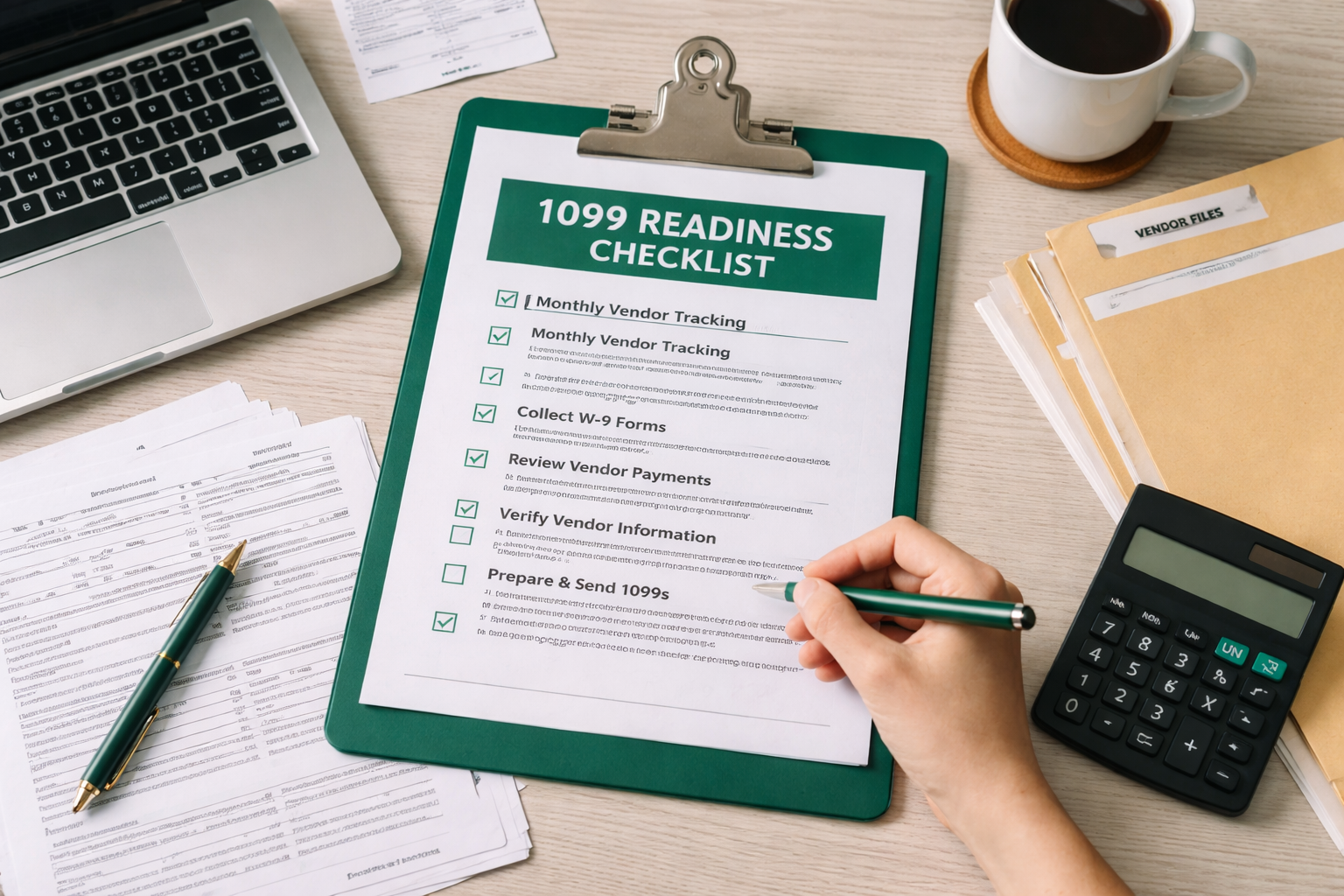
Free Checklist: 1099 Readiness Monthly Checklist (Year-Round)
Staying on top of 1099s is one of those tasks that’s easy to push off—until January hits and the scramble begins. A simple, repeatable system can turn that chaos into a routine. That’s where a year-round 1099 readiness checklist comes in.
Use the monthly 1099 checklist below to keep your records clean, your vendors organized, and your business compliant long before 1099 season arrives.
Why You Need a Year-Round 1099 Readiness Checklist
Waiting until year-end to deal with 1099s often leads to:
- Missing or incorrect vendor information
- Last-minute W-9 chasing
- Inaccurate totals and rushed reporting
- Higher risk of penalties and amended forms
By following a structured 1099 compliance checklist every month, you spread the work across the year, catch issues early, and reduce stress. This approach is especially valuable if you have many independent contractors, service providers, or new vendors coming on board regularly.
Monthly 1099 Checklist: Core Tasks to Do Every Month
Use this 1099 readiness checklist as your recurring monthly process. You can turn it into a calendar reminder or a recurring task in your accounting software or project management tool.
1. Review New Vendors
Each month, review newly added vendors:
- Confirm whether each vendor is an individual, LLC, partnership, or corporation
- Identify which vendors are likely 1099-eligible (typically non-employee individuals/LLCs providing services, not goods)
- Flag those vendors in your accounting system as “1099 vendors”
This step is the foundation of your vendor 1099 tracking checklist and prevents surprises at year-end.
2. Collect and Verify W-9 Forms
If a vendor is 1099-eligible, ensure you have a valid W-9 on file:
- Request a W-9 before the first payment whenever possible
- Verify legal name, business name, address, and Taxpayer Identification Number (TIN)
- Check that the tax classification box is correctly selected
- Store W-9s securely (digitally or in a locked file)
If any vendor is missing a W-9, add them to a “follow-up” list and don’t remove it until the form is received and verified.
3. Check Vendor Details Against Your System
Each month, compare W-9 details to what’s in your accounting software:
- Match vendor name and spelling
- Confirm the correct tax ID number is entered
- Ensure mailing address is current
- Verify the vendor is properly marked as 1099-reportable if applicable
This simple cross-check keeps your 1099 compliance checklist clean and reduces the risk of mismatched records when forms are generated.
4. Reconcile Payments to 1099 Vendors
Run a report of payments made to 1099 vendors that month:
- Confirm each payment is coded to the correct expense account
- Ensure payments are classified correctly (services vs. reimbursements vs. materials)
- Note any unusual or large payments for additional review
This gives you an ongoing, accurate picture of cumulative 1099 amounts rather than guessing in January.
5. Track Year-to-Date Totals
Each month, update or review year-to-date totals for each 1099 vendor:
- Confirm vendors approaching the reporting threshold (typically $600)
- Identify any vendors who have exceeded the threshold but are missing W-9s
- Maintain a simple vendor 1099 tracking checklist with columns for:
- Vendor name
- W-9 received (Y/N)
- YTD payments
- 1099 required (Y/N)
By year-end, this log becomes your quick-reference 1099 season prep checklist, saving hours of report-running and data cleanup.
Quarterly Deep-Dive Add-On (Optional but Recommended)
In addition to your monthly 1099 checklist, do a slightly deeper review once per quarter:
1. Audit Vendor Categories
- Confirm vendors are categorized properly (contractor vs. supplier)
- Revisit any vendors whose work has changed (e.g., from goods to services)
2. Spot-Check Documentation
- Randomly select a few 1099 vendors
- Confirm W-9, contact details, and payment history are all correct
These quarterly touchpoints strengthen your 1099 readiness checklist and catch anomalies before they snowball.
Year-End 1099 Season Prep Checklist
If you’ve followed the monthly process, year-end should be mostly confirmation, not chaos. In December or early January:
- Run a final 1099 vendor report from your accounting software
- Match report totals to your vendor 1099 tracking checklist
- Confirm addresses and emails one last time
- Resolve any missing W-9s immediately
- Generate and review draft 1099s for accuracy before filing
This final 1099 season prep checklist ties together all your year-round work and positions you for smooth, timely filing.
How to Use This Checklist in Your Business
To make this monthly 1099 checklist actually stick:
- Assign clear ownership (bookkeeper, accountant, or office manager)
- Add recurring calendar reminders (e.g., the 5th of every month)
- Document the steps in your internal procedures or SOPs
- Review the process annually and adjust as your vendor base grows
With a consistent 1099 readiness checklist in place, compliance becomes a routine habit instead of a seasonal headache.
Simplify This With Debits
Debits helps accounting firms handle exactly what this article covers. No spreadsheets, no chasing clients, no guesswork.
- 1099 Preparation — Included with bookkeeping
- Uncategorized Transactions — $2/client/month