Free Checklist: Month-End Close Checklist for Bookkeeping Teams
Closing the books each month doesn’t have to be chaotic. With a clear month-end close checklist, bookkeeping teams can work faster, reduce errors, and deliver accurate financials on time.
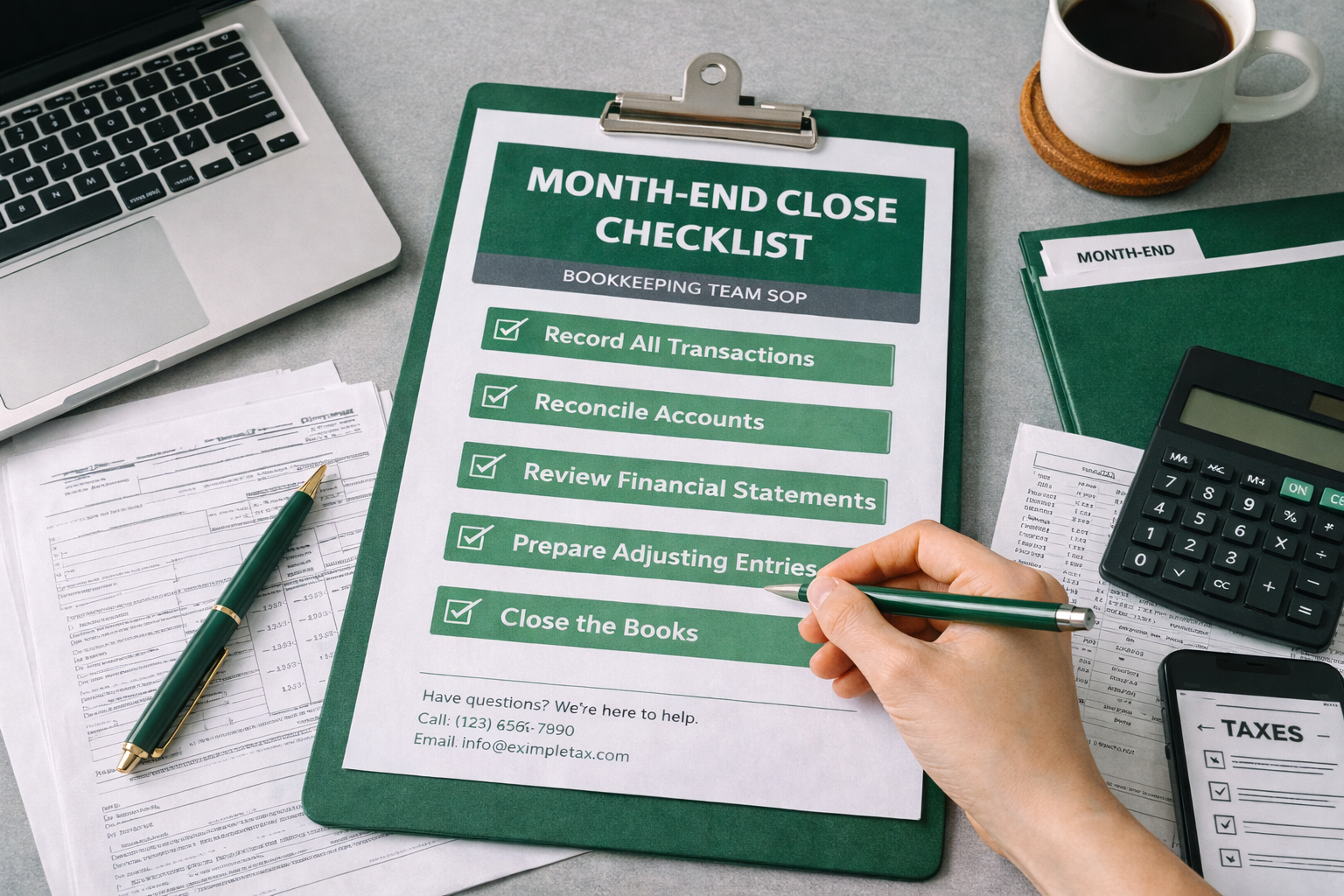
Below is a free, ready-to-use close checklist template you can adapt into your own bookkeeping close SOP. Use it as a monthly bookkeeping checklist and customize it for your systems, industry, and reporting needs.
Why You Need a Structured Month-End Close Checklist
A documented process helps your team:
- Standardize tasks across clients and entities
- Avoid missed steps and last-minute scrambling
- Shorten the close timeline
- Improve accuracy and audit readiness
- Create clear ownership and accountability
Treat this as your base month-end review checklist, then refine it with your own internal controls and workflows.
Pre-Close: Collect and Confirm (Day 1–3)
These tasks ensure you have all the information necessary before you start posting final entries.
1. Gather Source Documents
- Bank statements for all accounts
- Credit card statements
- Loan and line of credit statements
- Merchant processor reports (Stripe, PayPal, etc.)
- Payroll reports and journals
- Vendor bills and receipts
- Customer invoices and sales reports
- Inventory reports (if applicable)
Confirm you have complete data for the full period before you move on.
2. Lock Prior Periods
- Ensure the prior month and earlier periods are locked in your accounting software
- Confirm no backdated entries have been posted since last close
- Document any allowed post-close adjustments separately
This step protects the integrity of your financial history and is essential to a robust bookkeeping close SOP.
Core Close: Reconcile and Review (Day 3–7)
This is the heart of your monthly bookkeeping checklist.
3. Bank and Cash Reconciliations
- Reconcile all bank accounts to the month-end bank statements
- Investigate and resolve any unreconciled transactions
- Confirm outstanding checks and deposits in transit
- Verify petty cash and cash-on-hand balances
4. Credit Card and Loan Reconciliations
- Reconcile all credit card accounts
- Match charges to receipts and expense categories
- Reconcile loan balances to statements
- Record interest and principal allocations correctly
5. Accounts Receivable Review
- Verify all invoices for the month are issued and dated correctly
- Apply customer payments and credits
- Match deposits to customer invoices and AR reports
- Review aged receivables and flag overdue accounts
- Record bad debt provisions if applicable
6. Accounts Payable Review
- Enter all vendor bills and expenses for the period
- Confirm recurring bills (rent, utilities, subscriptions) are recorded
- Match purchase orders, bills, and payments (3-way match where used)
- Review aged payables and identify overdue or disputed items
- Accrue expenses for missing but expected bills
Adjustments: Accruals, Deferrals, and Estimates (Day 7–9)
This section of the month-end close checklist ensures your financials reflect the period accurately, not just the cash movements.
7. Revenue and Expense Cutoff
- Verify revenue is recognized in the correct month
- Ensure expenses are recorded in the period incurred
- Review large or unusual transactions for proper coding
8. Accruals and Prepayments
- Record accruals for unpaid but incurred expenses (e.g., utilities, contractors)
- Amortize prepaid expenses (insurance, software, rent)
- Review and update deferred revenue schedules
- Adjust prepaid and deferred balances to supporting schedules
9. Fixed Assets and Depreciation
- Record new fixed asset purchases and disposals
- Update the fixed asset register
- Post monthly depreciation entries
- Review for asset impairments or write-offs if necessary
10. Inventory and COGS (If Applicable)
- Reconcile inventory quantities to system reports or counts
- Record inventory adjustments and write-downs
- Review and post cost of goods sold (COGS)
- Reconcile inventory subledger to general ledger
Financial Review: Analysis and Quality Control (Day 9–11)
Your month-end review checklist should always include high-level analysis to catch issues before reports go out.
11. Trial Balance and Account Review
- Run a trial balance and scan for unusual balances
- Compare major account balances to prior month and prior year
- Investigate large variances and anomalies
- Confirm all suspense and clearing accounts are cleared or explained
12. Financial Statements Preparation
- Prepare the profit and loss statement
- Prepare the balance sheet
- Prepare the cash flow statement (if part of your reporting package)
- Confirm subtotals, classifications, and presentation
13. Management Review and Sign-Off
- Provide draft financials to the controller or CFO
- Document questions, assumptions, and pending items
- Make approved adjustments and reissue final reports
- Obtain formal sign-off according to your bookkeeping close SOP
Wrap-Up: Documentation and Process Improvement (Day 11–13)
Close the loop by documenting what happened this month.
14. Documentation and Audit Trail
- Save reconciliations, schedules, and key reports
- Archive supporting documents in an organized folder structure
- Note any unusual items and their explanations
15. Close the Period in Your System
- Lock the month in your accounting software
- Restrict backdated entries unless formally approved
- Update your close log with completion dates and owners
16. Process Review
- Note recurring issues (missing documents, frequent adjustments)
- Update your close checklist template with improvements
- Adjust deadlines and responsibilities for next month
How to Implement This Monthly Bookkeeping Checklist
To make this month-end close checklist work for your team:
- Turn it into a shared task list (project management tool or spreadsheet)
- Assign each step to a specific owner with due dates
- Add system-specific steps (QuickBooks, Xero, NetSuite, etc.)
- Review and refine the checklist quarterly
Used consistently, this structured month-end close checklist becomes the backbone of reliable, scalable financial reporting for bookkeeping teams.
Simplify This With Debits
Debits helps accounting firms handle exactly what this article covers. No spreadsheets, no chasing clients, no guesswork.
- 1099 Preparation — Included with bookkeeping
- Uncategorized Transactions — $2/client/month