
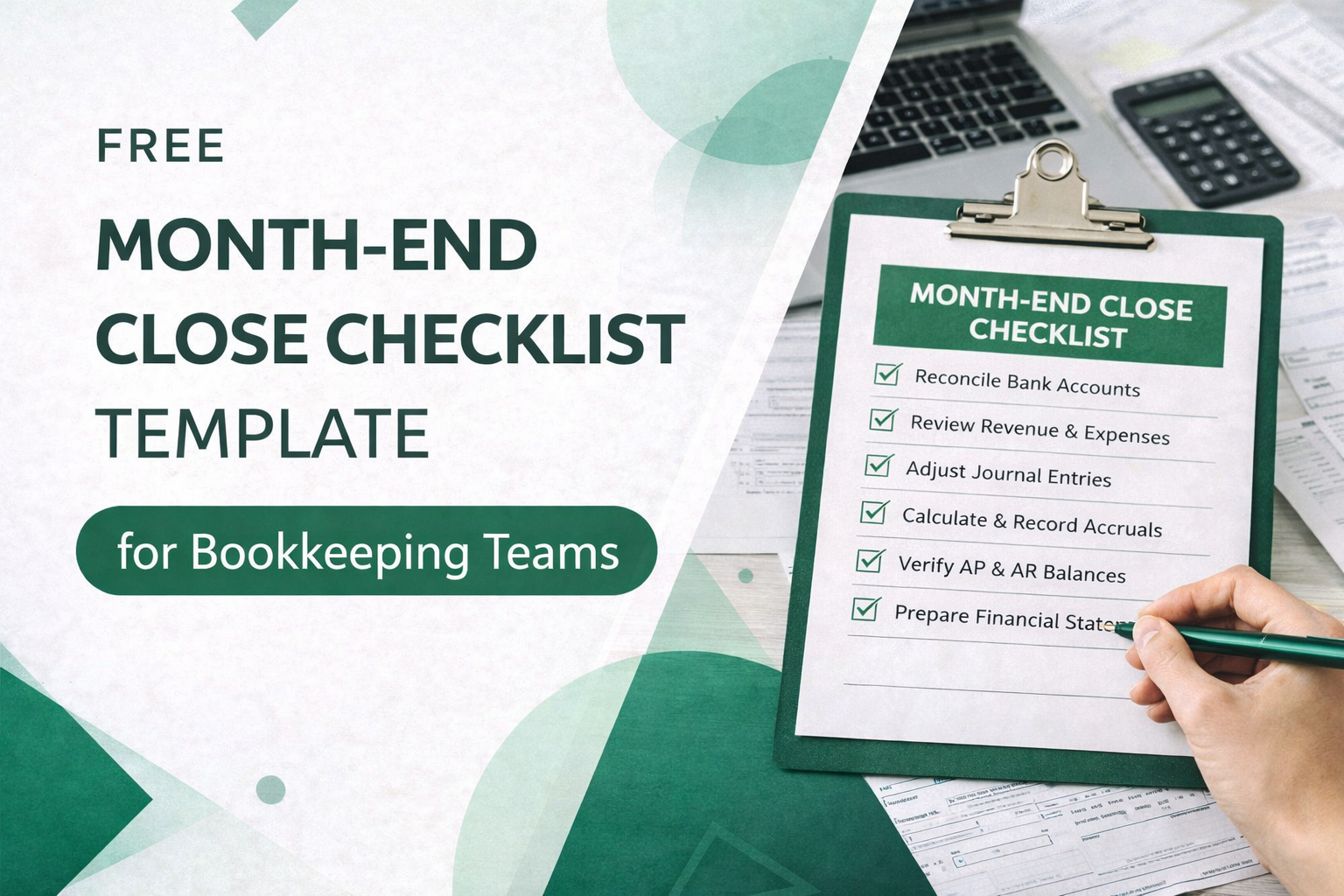
Free Checklist: Month-End Close Checklist for Bookkeeping Teams
Month-end can make or break your finance function. When the close is smooth, leadership gets timely, accurate numbers. When it’s not, your team scrambles, errors slip through, and trust in the financials drops.
A clear, repeatable month-end close checklist turns chaos into a consistent process. This article walks through a complete monthly bookkeeping checklist you can adapt as your bookkeeping close SOP—plus a ready-to-use close checklist template you can copy, customize, and share with your team.
What Is the Month-End Close (and Why It Stalls)?
The month-end close is the process of finalizing your financial records for a specific month. It includes:
- Ensuring all transactions are recorded
- Reconciling key accounts
- Reviewing for accuracy and completeness
- Producing financial reports
Where teams usually struggle:
- Tasks live in people’s heads, not in a documented checklist
- Dependencies (e.g., getting sales or payroll data) aren’t tracked
- No standard month-end review checklist, so quality varies by preparer
- Deadlines and owners are unclear, so things slip
A formal bookkeeping close SOP solves this by defining:
- What needs to be done
- In what order
- By whom
- By when
- With what supporting documents or tools
Key Components of an Effective Bookkeeping Close SOP
Before we dive into the free close checklist template, it helps to know what makes a good SOP actually work in real life.
1. Task Ownership and Deadlines
Each item on your monthly bookkeeping checklist should have:
- A clear owner (not “the team”)
- A due date (often working days after month-end, e.g., “Day +3”)
- A backup or delegate, if the primary owner is unavailable
This allows you to track bottlenecks and keeps everyone accountable.
2. Standardized Documentation
For each recurring task, your SOP should specify:
- Where to find the data (source system, folder path, vendor portal)
- How to perform the task (short step-by-step or link to a more detailed SOP)
- What “done” looks like (e.g., “All bank accounts reconciled with no unreconciled items older than 30 days”)
Standardization reduces errors and speeds up onboarding for new team members.
3. Built-In Review and Approval
A strong month-end review checklist includes:
- Specific items to review (e.g., “Check for negative inventory,” “Scan P&L for unusual variances”)
- Required reviewers (e.g., Senior Bookkeeper, Controller)
- Evidence of review (e.g., checklist sign-off, comments in your accounting system, or approval in your task tool)
This adds quality control and helps catch issues before financials reach leadership.
4. Tools and Automation
Your bookkeeping close SOP should acknowledge the tools you already use and where automation can help:
- Bank feeds and auto-categorization rules
- Recurring journal entry templates
- Saved report templates in your accounting system
- Workflow tools (Asana, ClickUp, Notion, spreadsheet trackers)
Even small automations—like recurring tasks and report templates—can shave hours off each close.
Free Month-End Close Checklist Template
Below is a practical month-end close checklist you can adapt. Think of this as your base close checklist template. Copy it into your task manager, spreadsheet, or SOP document and customize as needed.
For each task, assign:
- Owner
- Due date (e.g., Day +2 after month-end)
- Status (Not Started / In Progress / Complete)
1. Pre-Close Data Capture (Days -3 to 0)
These steps ensure all relevant activity is in your systems before you start reconciling.
1.1 Revenue and Sales
- Confirm all sales invoices for the month are created and sent
- Ensure all sales are recorded in the accounting system (including e-commerce or POS integrations)
- Verify that deferred revenue entries (if applicable) are posted correctly
- Check for unbilled revenue or manual sales entries that need to be accrued
Example:
If your SaaS business bills customers on the last day of the month, create and post these invoices before you begin the close. Make sure your subscription tool and accounting system agree on total monthly billings.
1.2 Expenses and Payables
- Enter all vendor bills received during the month
- Record credit card spend, including missing receipts
- Capture employee expense reports submitted by the cutoff date
- Identify any major expenses incurred but not yet billed (for accruals)
1.3 Payroll and HR-Related Items
- Confirm payroll entries for the final payroll of the month are recorded
- Book employer taxes and benefits if not automatically recorded
- Accrue salaries or wages for days worked but not yet paid (if material)
1.4 Cash and Banking
- Download or sync all bank, credit card, and loan transactions through month-end
- Confirm that bank feeds are up-to-date with no missing days
- Obtain bank statements and loan statements for all accounts
2. Core Closing Activities (Days +1 to +3)
Here’s the backbone of your monthly bookkeeping checklist: reconciling and posting necessary adjustments.
2.1 Bank and Credit Card Reconciliations
- Reconcile all bank accounts to statements as of month-end
- Reconcile all credit card accounts to statements
- Investigate and clear unreconciled items
- Flag any transactions that require follow-up (e.g., unknown deposits, duplicate charges)
Tip:
Set a standard like “No unreconciled transactions older than 30 days” as part of your SOP.
2.2 Accounts Receivable
- Reconcile A/R subledger to the general ledger
- Review aging report for overdue invoices
- Identify invoices that may require an allowance for doubtful accounts
- Apply customer payments and credits correctly
- Investigate unapplied cash or credits
2.3 Accounts Payable
- Reconcile A/P subledger to the general ledger
- Review aging report for overdue or unusual balances
- Confirm there are no duplicate vendors or duplicate bills
- Check for vendor credits not yet applied
2.4 Inventory and Cost of Goods Sold (If Applicable)
- Reconcile inventory balances to physical counts or inventory system
- Adjust for shrinkage, write-offs, or damages
- Review cost of goods sold for reasonableness (e.g., as % of revenue vs. prior months)
- Check for negative inventory quantities and resolve them
2.5 Fixed Assets and Depreciation
- Record purchases of fixed assets for the month
- Post monthly depreciation entries
- Dispose of assets sold or retired and record gains/losses
- Reconcile fixed asset subledger or schedule to the general ledger
2.6 Accruals and Prepaids
- Review major expense categories for missing accruals (e.g., utilities, professional fees, bonuses)
- Post accrual entries for expenses incurred but not yet billed
- Review and amortize prepaid expenses for the month
- Update schedules for recurring accruals and prepaids
2.7 Loans, Credit Lines, and Interest
- Reconcile loan balances to lender statements
- Record interest expense and any fees
- Confirm principal vs. interest allocations are correct
- Check covenants or required reporting, if applicable
3. Month-End Review Checklist & Approvals (Days +3 to +5)
This is your month-end review checklist, aimed at catching errors before financials are shared.
3.1 Balance Sheet Review
- Compare ending balances to prior month and same month last year
- Investigate unusual fluctuations or large new balances
- Ensure all suspense or clearing accounts have explanations
- Confirm that intercompany balances (if any) tie out between entities
Example items to review:
- Cash: Any unexpected drops or negative balances?
- A/R: Is the aging worsening? Any large new customers?
- Inventory: Any large adjustments, write-offs, or negative quantities?
- Liabilities: Any new loans or large accruals added?
3.2 Profit & Loss (Income Statement) Review
- Compare revenue and key expense categories to:
- Prior month
- Same month prior year
- Budget or forecast (if available)
- Investigate large variances (both positive and negative)
- Check for miscodings (e.g., payroll coded to supplies, one-time legal fees hitting a regular expense line)
- Ensure non-operating items are recorded in the right section (e.g., below operating income)
3.3 Compliance and Tax Items
- Confirm sales tax payable balances and filings for the month
- Check payroll tax filings and payments
- Verify any required local or industry-specific filings are scheduled or complete
- Ensure documentation is stored for audits (e.g., sales tax exemptions, W-9 forms)
3.4 Review Sign-Offs
Define and document your review process:
- Preparer review: Bookkeeper or staff accountant checks their own work against the checklist
- First-level review: Senior bookkeeper or accounting manager reviews reconciliations and key reports
- Final review: Controller, finance manager, or owner reviews summarized financials
Each level should:
- Sign or approve the checklist (physically or digitally)
- Note any issues, corrections, or follow-ups required next month
4. Reporting and Communication (Days +5 to +7)
Once the numbers are ready, your bookkeeping close SOP should outline how you deliver insights.
4.1 Standard Reports to Produce
Common monthly reports include:
- Balance Sheet
- Profit & Loss (P&L) – current month and year-to-date
- Cash Flow Statement (if maintained monthly)
- A/R and A/P aging reports
- Inventory valuation (if relevant)
- Department or project P&L (for larger or segmented businesses)
Set a standard report package that you produce every month so stakeholders know what to expect.
4.2 Custom Management Dashboards
Optional but powerful:
- KPI dashboards (e.g., gross margin, AR days, cash runway)
- Budget vs. actual comparisons
- Trend analysis charts (e.g., 12-month revenue, expense trends)
These can be built using:
- Your accounting system’s built-in dashboards
- Spreadsheet models
- BI tools like Power BI or Looker Studio
4.3 Communicating Results
Define how you communicate your results:
- Who receives the monthly financial package (owner, leadership team, department heads)?
- How do you deliver it (email, shared drive, dashboard link)?
- Do you include a brief written commentary or summary of key changes?
Example of a short commentary:
“Revenue increased 12% vs. last month, driven by new enterprise customers. Gross margin improved 3 points due to reduced shipping costs. Marketing spend was up 20% due to a one-time campaign. Cash decreased by $40k due to inventory purchases ahead of Q4 peak.”
5. Continuous Improvement: Closing Faster and Better
Once your month-end close checklist is up and running, schedule a brief debrief each quarter.
5.1 Analyze Close Timelines
- How many days did the close take this month?
- Where did you see delays (e.g., waiting on payroll data, late expense reports)?
- Which tasks consistently complete on time and which do not?
Use this information to adjust due dates, owners, or dependencies.
5.2 Refine the Checklist
- Remove tasks that are no longer relevant
- Add tasks for new products, entities, or systems
- Split large, vague tasks into smaller, clearer ones (e.g., “Reconcile balance sheet” → “Reconcile bank accounts,” “Reconcile AR,” etc.)
5.3 Add Automation and Templates
Look for easy wins:
- Create recurring journal entries for standard accruals
- Set up saved report templates in your accounting software
- Use rules for common bank feed categorizations
- Move your checklist from a static document into a project management tool with recurring tasks and reminders
Sample Month-End Close Checklist Snapshot
Here’s a compact view of a close checklist template you can copy:
- Pre-Close
- [ ] All sales invoices entered and sent
- [ ] All vendor bills recorded
- [ ] Payroll entries posted
- [ ] Bank feeds updated and statements downloaded
- Core Close
- [ ] Bank accounts reconciled
- [ ] Credit cards reconciled
- [ ] A/R reconciled and aging reviewed
- [ ] A/P reconciled and aging reviewed
- [ ] Inventory reconciled (if applicable)
- [ ] Fixed assets updated, depreciation posted
- [ ] Accruals and prepaids updated
- [ ] Loans reconciled, interest recorded
- Review & Approvals
- [ ] Balance Sheet reviewed vs. prior month
- [ ] P&L reviewed vs. prior month and budget
- [ ] Sales tax and payroll tax checked
- [ ] Preparer sign-off
- [ ] Reviewer sign-off
- [ ] Final approval
- Reporting
- [ ] Standard financial package generated
- [ ] KPIs updated (if applicable)
- [ ] Summary commentary drafted and shared
Conclusion
A reliable month-end close checklist turns the close from a stressful, error-prone scramble into a structured and predictable process. By documenting a clear monthly bookkeeping checklist, defining owners and deadlines, and building a robust month-end review checklist, your team can close faster, with fewer surprises, and deliver financials leadership can trust.
Use the close checklist template above as the foundation of your own bookkeeping close SOP. Start simple, refine it each month, and let your process improve right alongside your business.
Simplify This With Debits
Debits helps accounting firms handle exactly what this article covers. No spreadsheets, no chasing clients, no guesswork.
- 1099 Preparation — Included with bookkeeping
- Uncategorized Transactions — $2/client/month